Tuesday, 24 April 2012

Stones of Estonia (6)

The weekend


Tired and unfocused after last night’s fun, I stumbled a lot around the dark red oil shale rocks in our next site. I did not quite catch where we were exactly, because it was not according to schedule. Actually, none of the sites we visited this day were planned, but the localities we had intended to go to first were closed, or unavailable for other reasons I cannot recall. Not that that was bad in any way, it’s just that I did not know where we were. (If anyone who knows me well would describe me in three words, I am sure two of them will be “generally disoriented”.) Our guide mentioned Kukersite, which sounds like a site, so I thought that was the name of this place, but I checked it up, and kukersite is actually a type of Estonian Ordovician marine oil shale – kukersite is the type of rock, not the name of the locality.
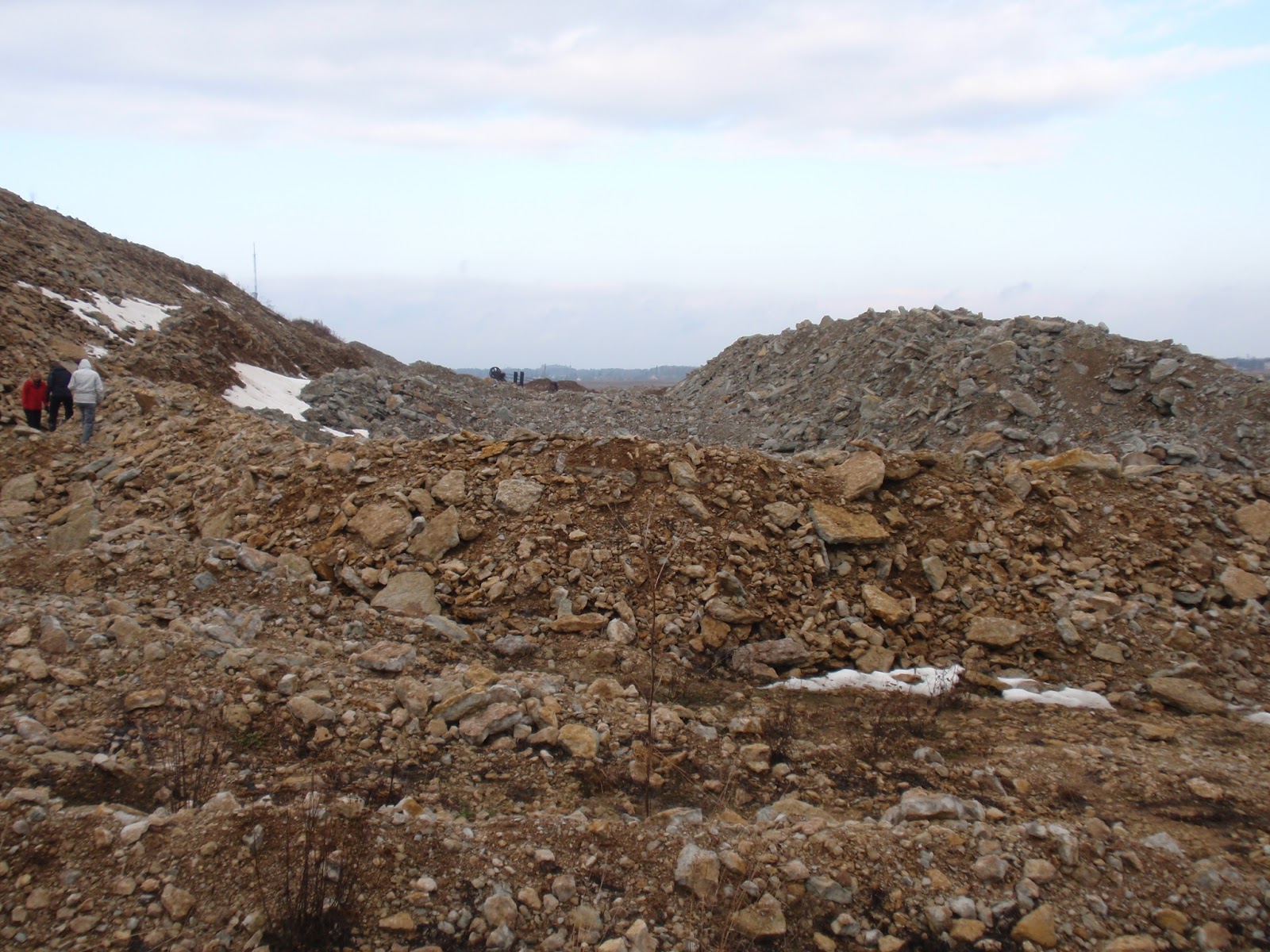

This, our guide said, was an incredibly diverse fauna, with over 200 identified species! The environment would have been a very rich marine environment, which is unusual for oil shales. This rock type has a high content of organic matter, and therefore usually forms in anoxic conditions, where the decomposing microbes do not have enough oxygen to break down the dead organic matter, which instead is preserved in the rock, if buried by sediment. This habitat, however, was clearly teeming with life, and would thus have been full of oxygen (otherwise, so many animals could not have lived there), which attributes the high amount of organic matter in the shale to the fact that there actually was so much life there that the sediments that later buried the environment would have been full of organic material.


The brachiopods of this locality were wonderfully well-preserved, three-dimensionally with shell and all. I found a complete rhynconelliform (I think), slightly larger than a thumb nail, beautifully preserved with clear shell details, but it somehow got lost on the way back to the bus, possibly because I put it in the same pocket as I had my gloves; it might have fallen out as I took the gloves to put on my cold hands. A terrible mistake I hope will be the first and last of the sort! I was quite demoralised after that.

There are also few pictures from this locality, as I was “busy” searching for trilobites. I had already found an impressive brachiopod, and I did not expect that I would eventually lose it, so I went after a second trilobite find. Stephen picked up trilobite after trilobite, so you can imagine how jealous I was when I could not find anything except a weird mark that looked like one, with a little imagination and a great deal of wishful thinking.
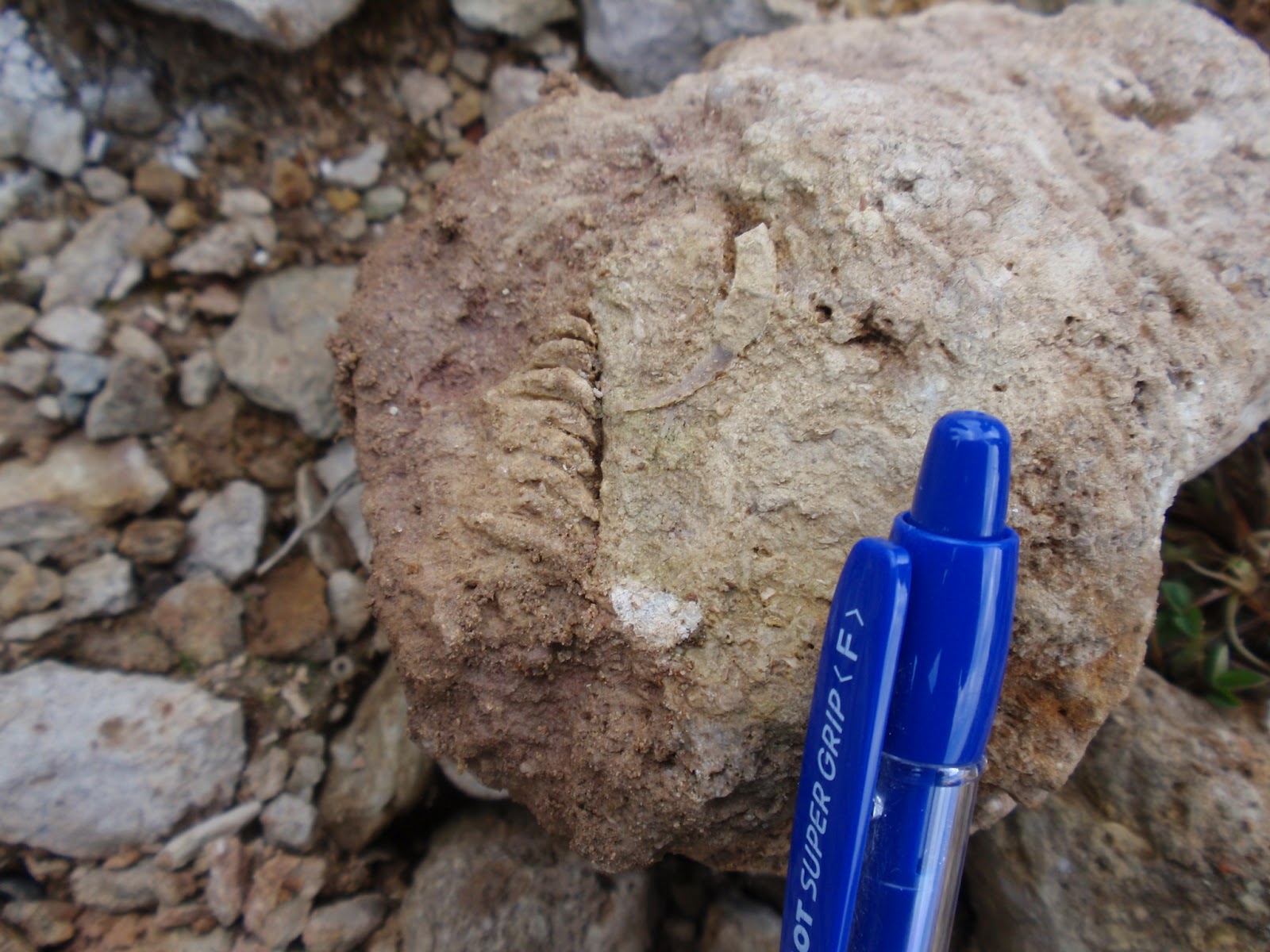

Although I did find something for the first time in this trip: an orthocone, a type of straight-shelled cephalopod, related to squids and octopi (plural of octopus; things ending with -us get their end changed into -i in their plural form, e.g. cactus, fungus, mucus). (Note: that last example was a joke, in case you did not realise; mucus does not even have a plural form.) The orthocone preservation is rather remarkable. Usually, as for example typically seen in old marble stone floors, the shell structure is what is preserved, where you also can see the inward-curved walls (septa) dividing the shell into several small chambers. In this specimen, however, the shell has vanished, and the chambers are preserved instead. The shell minerals have probably been dissolved away, leaving only the already solidified sediments that filled the chambers.

The last picture I include mostly to show the importance of having a scale in the picture.


These trace fossils look enormous, mostly because the people in the background seem small. Really, they are just standing far away – more than ten metres – but it is hard to tell since you cannot see the ground. I am also standing quite close to the fossil block with my camera, but it is impossible to tell how near I stand. I only have a rough idea of the diameter of the burrows, but I will leave it untold, and let you guess instead. It’s more frustrating that way.

The final fossil site we went to was another cliff exposure with early Ordovician limestones near a small stream.


The exposure was barely broad enough for all of us to look at it at the same time, and the area between the cliff and the stream was a narrow, steep heap of rock fragments. Therefore, our teachers were kind enough to skip any detailed examining of the cliff layer sequence. They definitely knew all about it and certainly had a lot to say, but decided to be merciful and let us roam for fossils instead.

It was quite hard to find anything. I had probably been looking around for ten minutes without seeing a single fossil before I began to give up hope. But, the persevere prevail – I picked up a rock, turned it over, and there it was: a tiny but oh so clear trilobite!


Trilobites are called so because their bodies are divided into three lobes: the axial lobe, running centrally from head to hindpart, and two pleural lobes on the sides of the axial one. Now, you probably wonder what a lobe is, and, honestly, I am not quite sure. The Concise Oxford Dictionary (seventh edition) defines a lobe as a “roundish and flattish projecting or pendulous part, often one of two or more such parts divided by a fissure”. The former part seems to be more applicable to the earlobe, and the latter seems to be a rather vague description. This confusion is not made easier by the fact that trilobites are also clearly dividable into three parts across their length too: the cephalon (head), thorax (main body, containing the legs etc.) and pygidium (hind part, almost like a short tail). Since it is quite unclear what a lobe is, it is easy to think that the tripartite division is between these parts. (A word of warning: this opens up a possibility for a trick question on any trilobite-related exam, so make sure you remember that the lobes run along the length axis.)

Curiously, the fossil I picked up had only the pleural lobes preserved – the centre was missing, and so was the head and maybe the tail. Since the head part is gone, it might be impossible to tell how large this trilobite actually was, since the thoracic segments vary greatly between different species. In other words, we cannot tell how much of the animal had been cut off – is this just the tip of the hindpart, or is it most of the body?

Regardless, it is the prettiest trilobite I could ever dream of finding. I do not dare to try to break off the rock around it, although it is so soft it could easily be done by fingers. The risk of breaking this peculiar fossil is too great, since you never really know how a rock will break apart – it could just as well turn the trilobite into powder.

I had found a second trilobite, and not a weird thingy like at Ohesaare, but a clear specimen that even I myself could tell was definitely a trilobite! It would not win Graham’s competition, but it would certainly win my own.

Unless…

There, just lying there, completely exposed among the fragmented rocks and dirt, it was: another trilobite, so amazing that I could not believe it!


It was big, roughly the size of a thumbnail, and exquisitely preserved – although lacking the head. Here, you can clearly see the three lobes, and how they can be distinguished all the way down through the pygidium. It even looks as if the outer shell of the pygidium has been pealed off, revealing the internal structure of the tail part, but I do not dare claim anything for certain.

I feel false pride about having found this weird and truly wonderful trilobite, but it was really mere luck. It was so exposed that anyone who would have gazed upon it would have noticed what it was. My eyes just happened to look at the right place.

Still, that does not stop me being incredibly happy about it! And I could go on about how terrific this discovery was to me, how beautiful it is, and what a treasure it is for a beginner like me, but I will leave it at saying that it made it among the three winners of Graham’s trilobite tournament! I was guaranteed a lovely apple juice on the boat.

This was truly the climax of the trip, in terms of fossils, and conveniently at the last site. From here, we returned to Tallin to catch the ferry back home.

The last night was truly a night to celebrate, not only because it was the last night, but also because the following day was Heda’s birthday!

Not being a fan of alcohol, I restricted the celebration beverages to a sip of champagne and a try of port wine. When I chose my trilobite award drink to be a glass of apple juice, Stephen sighed and said that I failed the first test to becoming a paleontologist – drinking hard. Oh, well…

The ferry had the good taste of having a lot of Latin American music, which I realised is the only type of music I can manage to dance fairly well to. I think it is because the rhythm is weird enough – I cannot move to those regular pop beats… they are too normal.

A few years ago, the stench of cigarette smoke was utterly unbearable to me, but I have gotten more used to it, which is lucky, as the place where most people went to chat and get some fresh air was the smoking room. The fresh air bit might seem ironical (and it is), but the reason is that the smoking rooms were basically outside, with only a roof on our heads, the wind naturally blowing away the smoke. So, this was the place for conversation, which is my favourite part of socialising.

Illiam had earlier gone on about knowing the world’s most gruesomely brilliant limerick (a type of five-lined poem with a certain rhyme pattern – aabba – and usually a perverse twist in the end), but would not tell it, no matter how much we pleaded him. Finally, he said that he would tell it to anyone who was up after 3 am. Naturally, I had to stay up that long, but I could not find Illiam after that, so I never got to hear it anyway. For better or for worse?

Although it felt sad to leave my new friends in the morning, I knew I would see them again sometime, and I was longing to come home. It had been a truly fantastic adventure, but it was enough for now. All I wanted was to rest, and remember the taste of my mom’s wonderful food.  

Friday, 20 April 2012

Stones of Estonia (5)


Friday

I might as well say it from the start: this day became unforgettable.

We were back in mainland Estonia, and had now reached the Devonian period, which commenced 416 million years ago. The Devonian is usually referred to the “time of fishes”, because they diversified like crazy during this period. Our first stop was a river bank from this time period, located in Tori. If there was any chance of finding a vertebrate fossil, it would be here.


People had had fun here before us.


The geological significance of the marks stop at indicating that the rock is soft (unless we suspect cavemen, or drunk geologists equipped with sharp tools?). So, a true geologist would naturally only put attention to the cross-bedding (layers lying at angles to one another). I cannot read Estonian, but most of the words seem to be names.

Sadly, there was not a fossil in sight. This could only mean one thing: we had to do geology work. This, in turn, meant to examine the exposure.


The sandstone cliff was about six metres tall, and quite clearly dividable into three sections. The top one is marked by its darker red colour and the abundance of fairly large holes. The two segments below were sticking out slightly, further emphasising the distinction of the top part. The middle section was quite “normal”, with even bedding and few holes, while the base portion, ranging from the ground to about one metre up, had crazy cross-bedding. In the picture below is a clearer part of this feature. 


Cross-beddings mark gross changes in the main current direction (I think, but I am not entirely sure). Although it is not seen in the pictures, there was an overall general tilt down to the right (when facing the cliff), which might show the stream’s main flow direction throughout the long time span during which this part of the cliff was formed.

We also looked at the sandstone grains in more detail, using hand lenses. They were fairly rounded, mostly spherical, sand-sized and well-sorted (sorting is the degree of difference between the sizes of the particles in a rock: the more different particles sizes there are, the less sorted the rock is). This all screams long-distance transport by water.

So, the sediments had been transported a long way, meaning that the environment where they were formed was far away from here. How, then, could we be certain that these are river sediments? We cannot, really, since such features can be found in marine environments as well. However, the absence of marine fossils gives a good hint. It is likely that this was a river deposit.

My friend Sara was excited about our second stop: someplace in the middle of nowhere where they had a storage room for drill cores, which are basically long drilled-out tubes of bedrock, showing the layer sequence in inland areas, where the beddings are not exposed. I had a feeling this would mean a lot of really dirty work.

It started out great with a long walk through the muddiest terrain so far (only matched in this trip by the next stop to come). I cannot complain, though: I had rubber boots; others were not so lucky.

Even more luckily, there was no exercise about the drill cores. The idea was more to give us a more compact view of the stratigraphic change over time, which we had seen only patchily so far.


The most distinctive piece was the green glauconite bed from the Ordovician.


There was not really much to say about this. There was nothing more than rock.

Having that in mind, the following picture is just sad.


And that is only the left half of the room…

On the way back to the buss, I got to know Heda Agic, a PhD-student, who would later become a good friend. The walk didn’t feel muddy this time.

The final stop for the day was the Silurian Võhmuta limestone quarry, which looked like this when we arrived.


As mentioned before, this place was even muddier than before. Now you know why.

There were some fossils here, which can be seen in the picture below, although not very clearly.


This quarry was known as a massive Borealis brachiopod bed, but our brachiopod expert, Lars, had never seen this type before. They were indeed very weird brachiopods, looking more like smooth, elongated balls.

Because the place was flooded, and mucky, we decided to leave. There was not much we could do here, unfortunately. Our brilliant guide, Heiki, however, managed to grant us permission to enter a nearby quarry, currently in operation, where the same beds were exposed.


This was clearly the most tricky bed to examine throughout the entire trip. There were no clear sections; everything looked the same. We had to look closer, then.


We found an incredible mass of fossils, all apparently Borealis, except for a few large stromatoporoids (third picture below).


It was as if the rocks consisted more of fossils than of other minerals. Such limestones are called coquina.

The exposure was criss-crossed with bands of extremely concentrated fossil shells.


As remarkable as this was, all features were present everywhere on the outcrop, so they provided no tools for distinguishing layers. It was the same along the entire exposure. We just could not figure out what had happened here. 

Naturally, our teachers were able to clarify: this bed, being almost excessively dominated by a single type of organisms, was an example of the strange ecological forces that were operating back in the Silurian. Exactly what had happened is not understood, but it is different from what we see today, perhaps because we have different environments and animals now, etc.

This is actually really interesting, thinking that the laws and processes we see today might not have been the same in the past. It took a whole revolution within geology to recognise this, to accept that what geology was based on back then, the idea that “the present is the key to the past”, was not true. (Curiously, the debate about whether the extinction that exterminated the dinosaurs was caused by a meteorite from outer space or not, had a part in this revolution!) Nowadays, the saying has cleverly been rephrased into “the key to the past is in the present”, implying that we can learn about past times from what we can observe today, but that we must be open for the possibility that events unknown to us, events so rare that they have not reoccurred within our time of recorded history, also may have occurred.

About this particular example, however, we can also speculate about the idea that ecology evolves together with the organisms – that there is a reciprocal, two-way relationship. It is well-known that ecology causes organisms to evolve, but what if the organisms in turn can change the laws of ecology? It is not entirely daft, because ecology basically depends on the organisms. The food chain depends on the presence of producers and consumers; population ecology depends on the types of populations, and so on. Ahh, so many questions, so many fascinating questions!

Remember that I opened this post saying that this day would be unforgettable? Well, so far, it has not been much spectacular. It had been mostly muddy and weird.  The truly wonderful thing came at the hotel. A nice evening playing table tennis with the guys I shared the ferry cabin with, followed by a glorious plate of schnitzel (as we all noticed, when being in the field for a week, any food is a blessing!), and finally a crazy, late night with Heda, Iliam, Stephen, Aodhán, Sara, and others. This night, I made truly great friends, at least from my part.

Thursday, 19 April 2012

Stones of Estonia (4)


I could not believe it! The very first site on the next day, Kaugatuma cliff, at the southwest, long stick-out of the Saaremaa island, was just as full of fossils as Ninase! Apparently, this was one of the most fossiliferous localities of the Silurian period.

At the time of this formation, the Caledonian mountains had formed, by the three-front collision between western Scandinavia, northern Greenland, and the British Isles. This massive clash closed up some shallow marine environments in the vicinity, and there is a visible transition toward more terrestrial (land) conditions. However, this is not seen here, in Kaugatuma cliff, which contains some of the last marine communities in this place.

The shore was teeming with exquisitely preserved fossils, completely dominated by crinoids, which very much look like aquatic plants, but actually are animals. They are related to starfish and sea urchins, all belonging to the echinoderm group, united by a five-sided or pentagonal symmetry: crinoids have five tentacly projections around its main body, starfish have five arms, and sea urchins’ mouths are divided into five parts.

What is mostly preserved from the crinoids here, however, is their long stalk, which in some forms here were unusually large. If they are large and abundant, they must have been doing very well in this environment.


The above picture was taken in place; the four below are front and back of two rock pieces completely stuffed with crinoid fragments I found and brought back home.


Here is another nice fossil. Luckily, it was not stuck in the ground as most other similar specimens, so I could add it to my collection.


This is a section of a crinoid stalk, preserved in three dimensions, with the clear calcite rings it is made up of. Below is a specimen that is just a fragment of the outer part of the stalk. I am not sure of what would have been inside when this animal was alive, but it probably was slimy.


There were many fragments that had small, round holes. This is where the “roots”, which were used to anchor the long, slender creature into the seabed.


Among this crinoid jungle, we found corals, brachiopods, sponges, gastropods and even some trilobites. Professor Graham Budd had announced a competition: the best trilobite find would be rewarded with a free drink on the ferry back home. So most of us were searching vigorously for trilobites. Personally, I thought finding a trilobite would be a most awesome reward in itself, and I think many others agreed.

Brachiopods can of course rival trilobites in sheer beauty, but they could basically be found in every second rock you looked at or flipped over, so they were not quite as thrilling to search for. However, I miraculously found this:


And what was even more miraculous was that I did not lose it in my pocket later! I have to keep it safe, for any bird or rodent might easily take it for a seed.

No, but seriously, it is a truly wonderful specimen, by my standards, and definitely one of my favourites. I think it is a rhynchonelliform, or articulate brachiopod, based on its shape, but I guess one must crack the shell open to find out for sure. (I’m not going to do that!) Articulate brachiopods have teeth holding their two shells together, rather than muscles, in contrast to the craniiformeans, or inarticulate brachiopods, which rely on a complex set of muscles to keep the shells closed. Muscles require more energy to be sustained, so the rhynconelliformeans had an edge over the craniiform brachiopods.

It was a very chilly morning, and my hands were aching from the cold, so there was at least something positive when we left for the bus to take us further on.

Next, we arrived at another shore (surprise!), also with abundant fossils (yay!!). This was the Ohesaare cliff, a famous late Silurian fish locality, so there was some hope of maybe finding a vertebrate fossil. (One of our teachers, Lars Holmer, did find a fish scale fossil, but I never got the opportunity to see it, so I have no idea of what it looked like.)


Lamentably, we were supposed to do some serious exercise to really examine the exposed layer sequence. In the previous locality, there were no cliff exposures to examine, just a flat carpet of fossiliferous rocks. Here, however, we would not be able to avoid some rock work. 


There were fossil embedded in the exposed cliff rocks (can you find some on the picture below? look carefully, it’s not as clear as before), not just on the loose pebbles on the shore.

But, the purpose here was to do a so-called log of the exposure. This basically meant a proper scale drawing of the different sections we could see.


Luckily, the exposure was roughly evenly divided into four clear units, each around 50 cm thick, making the scale drawing easy on a lined paper.

Identifying the rocks in the layer, however, was a different story. The top section was dry, quite light grey to yellow limestone (investigated by an excited Aodhán with a bottle of hydrochloric acid, which fizzles if poured upon a calcium carbonate rock such as limestone); below was some dark grey, wet, yucky mud, with some lighter rocks embedded; next we had a section with some mud similar to the above one, but a lot more solid, light grey rock, once again limestone, I think; the base consisted of partly mud, partly darker rock (maybe stained by the mud).

I am not sure what to believe, but since only the three lower parts contained mud, and to a lesser amount in the lower layers, and because these three layers were wet, I want to interpret the mud as all belonging to the layer second to the top – if the groundwater table lies at this level, it may very well be that it is responsible for washing mud down to the lower layers. This sort of explains why the bottom sections contain less mud, and why they are wet too. However, this must be a slow process, or one that has begun relatively recently, because, otherwise, one would expect a thicker layer of mud accumulating at the bottom. It is a bit tentative, but particles are usually washed down in the ground profile by percolating water – there is even a beautiful word for this: eluviation.

So, the logging was done relatively quick, and was mostly forgotten when a Illiam Jackson, a PhD-studen, came cheering over having found huge bivalves (clams) stuck in the second-to-top bed mud. The next moment most of us were combing the exposure for them. They were not easy to find, despite being the size of a chicken egg, because they were of the same colour as the mud, so we had only the shape to go for.

It seemed hopeless at first, mostly because I was not sure of what their exact shape was, and how to distinguish them from the normal rocks pointing out of the mud.

However, perseverance paid off eventually. I found a half one. Too muddy to put in my pocket, I had to wash it in the cold water and roll it up in a paper napkin. Not exactly a professional handling of the fossil, but it had to do.


And now I knew what too look for, and – guess what – found two more! Now I had a fine collection of enormous Silurian bivalves!


However, this find was bleak in comparison to another discovery: my very first trilobite!


I actually found this piece before the bivalves, but it looked so strange – somewhat like a trilobite, but still not really. I hoped it was a trilobite, but doubted it. Later, however, I asked professor Budd to look at it, and he said it might be a very weird-angled cross-section of a trilobite. “But it’s not a winner”, he added, and I knew it, but was not bothered. I had found my own trilobite, and that certainly made my whole day, and the trip would be a success, even if this would be my last find.

Well, it wasn’t.  On the way back, my eyes came over some pretty awesome trace fossils, probably made by burrowing worms. Not as spectacular as the other fossils, but for being a trace fossil, or ichnofossil, it was rather impressive.


The final stop for the day was a bit of an anti-climax: a meteorite impact crater in Kaali. I tried to tell myself, and others, that it was nice for a change, but it was too sterile. Of course, you cannot expect much else from an impact crater, but in the light of the earlier localities, this was rather dull. Massive, but dull.


One impressive feature was the big blocks of rock that had been thrust up at an angle by the impact shockwaves.


Another interesting thing was the way the trunks of the trees growing on the crater ridge were curved. This is because the soil is slowly creeping down toward the centre, dragging the trees down, while the trees strive to grow upright, and therefore bend their stems so the crowns will face as much upward as possible, to reach the sunlight. The trees came after the crater had been formed, and so did the lake, of course. 


It had truly been a day of miracles. Yet, more was to come!