Monday the 11th of March we had another one-day fieldtrip with the first-year geology group, this time to a site within Bristol: the Avon Gorge.
As scary as the name sounds (I have no idea of what it means, but the words sound ominous), the only frightening thing was the size of it.
(And that bit continues below!)
(We went to a few other sites, but this exposure was the main part, and where all fossils were found, so I will only retell our adventures here.)
I have been very unproductive in terms of blogging of late, simply because I really need to do more schoolwork now than ever before, plus search for and arrange accomodation for next year, prepare for the one-week field session we are having during the break, and begin to plan my summer (work, rehabilitation exercise for my bad knees, and I want to bring some friends from Bristol over), and do not forget the scientific method post I am working on (which seems like it will be massive, so I am considering cutting it into pieces and publishing them one at a time instead of the whole thing when it is all finished...)!
(However, I am intending to resurge my blogging soon, and especially include more discussions around material from our classes. I have a few ideas that could be of interest! Hopefully, it will bring a new dimension to this blog. I will also try to resume the PalQuizes.)
So, for this fieldtrip, I will actually dismember the narrative to focus on the fossils only. (Really, they were the only fascinating bit: the rest fell pale, especially since, typically, that day was like the coldest day of the year!)
Some fossils were large and clearly visible from far away.
There are some clear echinoderms – starfish, to be precise – and a few indeterminate worm-like creatures I have never seen before, so it was quite fun to see something new.
We found plenty of crinoids in the exposure wall (though the first one could perhaps be a rugose coral...).
A really nice impression of a stalk plate:
Another impression, this time of the side of the stalk, showing the contours of several plates:
There were also plenty of rugose corals.
The last one is adorable! I think it was Nigel who found it. He finds all the nice ones, so it probably was. *grumble*
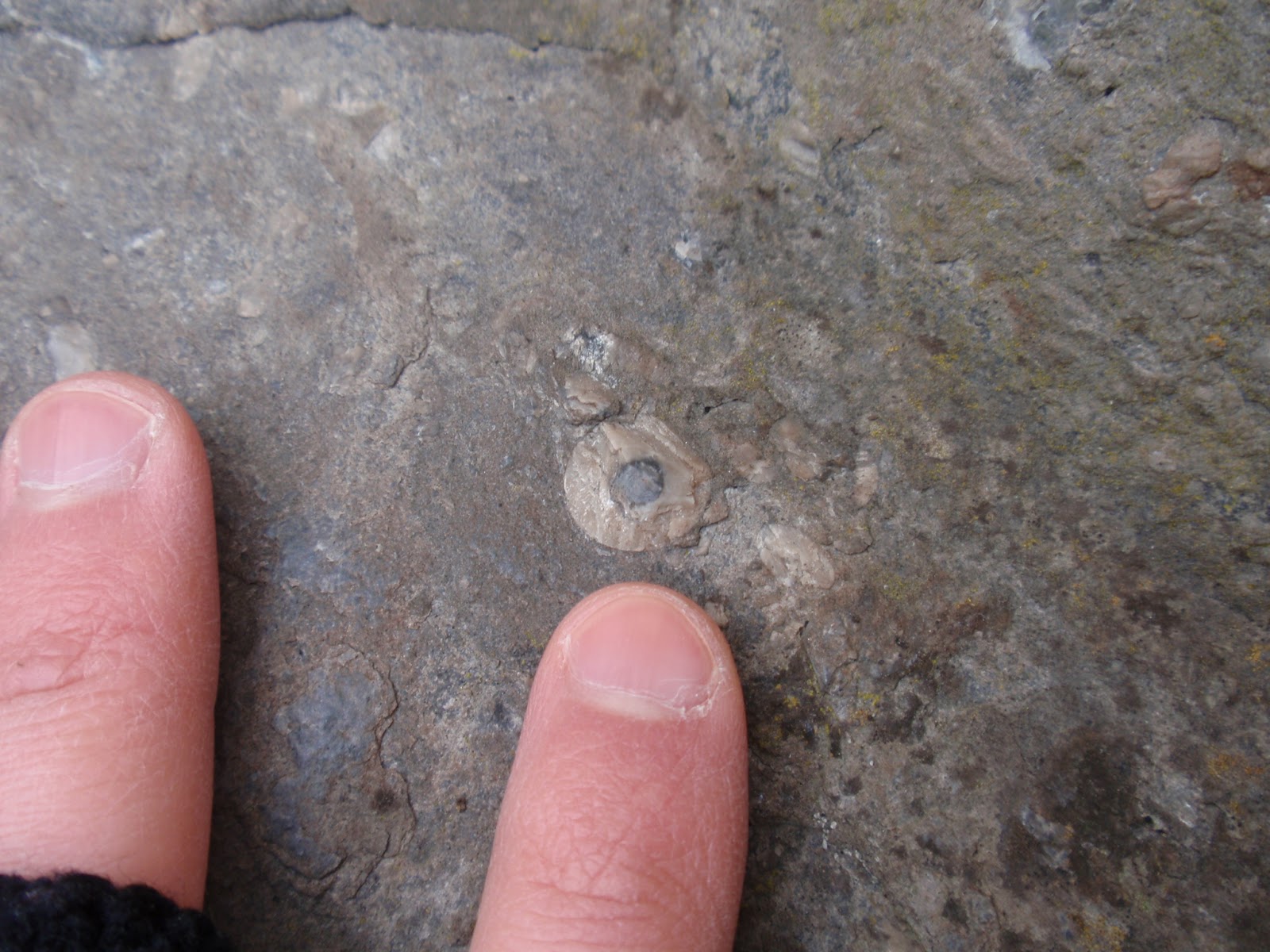
However, I did made one rather amazing find. We were told that there would basically only be crinoids and rugose corals here, and indeed, it seemed so...
*TAH-DAM-DAM-DAAAM*
... until I saw this:
Some form of shelled creature, most likely a brachiopod impression from the side. The top part would be its dorsal shell (upper shell) and the bottom its ventral shell (bottom shell), which is larger. In life, it would sit on the seabed on a fleshy stalk sticking out from the tip you can see on top right there, and it would sit upside down – i.e. with its ventral shell upward – and stick out a tentacly tongue-like structure from its other end (bottom left) to filter food particles from the water.
Brachiopods are one of my favourite invertebrate fossil groups, and this is one of the finest specimens I have seen in the field. A really successful day after all!
We also found plenty of fossils to bring back home, and I will show them in another post.
Monday, 18 March 2013
Tuesday, 26 February 2013
Sand Bay
Monday the 25th
of February, we went on a short fieldtrip with half the first-year geology
group to Sand Bay in
Weston-super-Mare, near Bristol.
The rocky shore
we were at is within the tidal zone, so during high tide, it lies under water.
We were therefore working under considerable time pressure, and the slightest delay could mean the lives of
every single member of the group!
No, just joking…
(I gave up puns for lent, so I have to make do with other forms of low humour.)
The tide does not come in that fast, and as long as you always keep an eye on
the water level, you should be fine. The greatest danger here would be standing
too close to those cliffs for too long.
But, again, be
careful with where you stand, and, if you have
to go up close, do it quickly and then go back immediately. If you do that,
there is little risk.
The beach was
full of round limestone rocks, nicely polished by the washing waves every day.
It did not take long before all paleontologists were scanning them for fossils.
As always, there
is this mysterious lag period where
you walk around, staring at the ground, but find nothing. You bend down to have
closer look, but still don’t see a thing of note. It is not until you find the
first that the rest start to crop up everywhere, even where just had just
passed – which ironically turns out to be packed with nice fossils that you for
some reason were blind to a minute ago.
The point of
this fieldtrip was to teach us certain geological field skills. The university
staff here seems to have a fetish for
the word ‘skill’, and gladly apply it to anything that relates to an
ability, no matter how undeveloped. I guess it is just that it sounds good when
you say that the students are acquiring skills in the field. It makes us sound
professional. (The same goes for the word ‘feedback’, but this is not the place
to be bitchy about the meaning of words…)
We had four
exercises to do. So, get on with it.
I don’t want to
sound cranky, but it is difficult not to, when the teachers do not even care to
show us how to do the things we are
tasked to do in the exercises. Half of us have never done fieldwork in geology
before. In the blistering cold winds, and surrounded by fascinating fossils,
the motivation for walking around and trying to guess what they want us to do
dropped to the bottom.
Luckily, James,
Nigel and I had done many of these things before, so we did fine, but there was
still much hesitation and standing with the notebook and pencil in
cold-shivering hands glaring at an outcrop in front of us, each probably having
an internal struggle to find any point in this. We want to search for and find
nice fossils!
In the end, we
did what we had to, but, in hindsight, it could have been done half as
painfully and in half the time if we had just been prepared properly by the staff
that has years of experience of these things and therefore should be able to go
through each step clearly and give tips from personal experience on how to make
things more efficient.
They did not
give much introduction to the history of this place, except for the brief notes
they had given us in a handout earlier. All we knew was that the rocks were
Carboniferous of age and formed in a shallow marine environment, and that there
were some volcanic sediments mixed around here as well.
The idea was for
us to start to investigate the environment for ourselves and try to puzzle some
pieces together, rather than having someone give us all the answers. Brilliant
pedagogical thinking, in theory at least. Honestly, I am glad they at least
try.
But argh, don’t
let me spoil this post by complaining so much! It was a really good day! It had
been so long since I saw fossils (in real life).
What I really
was hoping to find was a rugose coral,
since I don’t have any yet. I have plenty of tabulate corals – the other main type of corals at that time –
including my very first fossil. Both types of corals lived on the bottom of
shallow seas, filtering food particles directly from the water. That is about
as much as they did… (I’m not sure of how they reproduced, but cnidarian life
cycles tend to be quite interesting, so maybe the fun bits happened then!) The
tabulate corals grew in tight colonies, and so were very important for building
ancient reefs; the rugose corals were more solitary.
And some were
small enough to bring back home.
What has been
preserved is the calcareous outer skeleton it secreted outside its body; the
actual animal would live inside, protected from most danger, and let out its
tentacles to feed from the currents. Perhaps not the most fantastic of
organisms, but they make very nice fossils!
A really amazing
one I found embedded in a huge block of rock (too big to carry) (and too stuck
in the rock to pick out) could be a rugose coral preserved in very nice, large,
clear calcite crystals, but it could also be a crinoid (sea lily), another
filter-feeder, but related to starfish and sea urchins.
I found at least
one fossil that is surely a crinoid.
But only a cross
section of one of the hard plates of its stalk, so not really much to see.
Nigel, on the other hand, found a fantastic bit of its mouth and tentacles! It
was so incredibly nice, that James and (mostly) I were bitter and jealous for hours (not
really, but we pretended, because it was the best we could do… damn Nigel!
hahaha).
And as if it was
not enough, Nigel later found a huge rugose coral, only half attached to a
rock, the other side nicely showing its cone shape. Damn that man again!
I did find a
pretty fun crinoid fossil with its stalk plates sort of separated a bit.
I also picked up
something I am quite sure is a brachiopod.
And, finally, a
rock that looks just like the typical textbook model of dip-slip faults!
(If you are
unfamiliar with what that is, don’t worry… it is really only funny if you have
seen tons and tons of those diagrams before.)
In two weeks or
so, it is time for another fieldtrip, but this time probably with less fossils.
*sob*
Sunday, 24 February 2013
Preparation for fieldtrip
Today I have
done something unprecedented in my
time as a student: I have done some background
reading on the locality we are visiting on a fieldtrip with the geology
group tomorrow. Not really because I feel I need to, but I would like to
experiment and see if it does any good.
Much of this
year has been about experimenting with how hard I need to work to achieve
certain things. Being ‘independent’ means there is many more things that demand
time, so realising how much time is needed
to spend on schoolwork to achieve a high grade is crucial if I am to do well at
university. (So, it is not that I am lazy… hahaha!)
This time,
however, I want to test if it is worth the extra effort to be well prepared for
a fieldtrip. When it comes to an oral presentation or a written examination,
preparation is of course essential, but I suspect a field trip is more or less
like a practical or lab session: if you just follow the instructions given when
you are there and use your head, everything goes nice and smoothly.
We are going to
a site called Sand Bay, near
Weston-super-Mare, a bit away from Bristol. We will be examining (early)
Carboniferous rocks and fossils – so, quite a bit older than those I saw in
Estonia last April. The field guide says there are crinoids, brachiopods and
corals. That’s all I need to know. Fossils, here I come!!
On the powerpoint slide they showed us during our safety meeting (which wasn’t about safety at all), there was at least one picture of a rugose coral, so I hope to find one and fill that hole in my collection. Also, if I could find a crinoid calyx (feeding cup) with tentacles, the day would be a success regardless of weather! (Note that I am not allowed to make puns during lent time; that’s why I didn’t this time.)
Then there is also some volcanic stuff…
I really hope they will let us take some fossils back home. (As long as we do the work we are meant to do, I don’t see why not…)
Um… I realised there is really not much more worth mentioning at the moment… I’m sure there will be lots more to tell tomorrow when we come back from the real thing!
Friday, 22 February 2013
Breathing and warm-bloodedness – another old post
Having just started on my science post, and realising it will be longer than expected, I figure I should feed you some of the last useful posts from my old website. Also, this Monday we are having a one-day fieldtrip (we just found out...), so I might bring something worth telling from there as well. Meanwhile, I apologise for the time it is taking to write the big thing up, but stuff keeps coming up that need to be done – such is university!
Tetrapods
(land-living vertebrates) breathe because our internal chemical reactions
consume oxygen. Without oxygen, we would simply not be able to live. (This
should not surprise you.)
The chemical
reactions in question are described in detail in the article about aerobic
and anaerobic metabolism. Here, I will briefly summarise the key points.
Aerobic metabolism refers to a series of chemical reactions involved in aerobic cell respiration, which
basically uses oxygen to release energy from food for the cells to carry out
their functions. There is an alternative way of extracting energy from food
without the use of oxygen – anaerobic
cell respiration – but it consumes about twenty times as much food to
provide a given amount of energy.
There is a limit to
how much oxygen an animal can absorb; this depends on its lung capacity. A large
influx of oxygen is essential, because when the oxygen supply cannot meet the
energy demand of the cells (e.g. during intense activity), anaerobic cell
respiration must be used to supply the additional energy required – which is
undesirable since it consumes much more food.
Lung capacity can
partly be related to posture. Dinosaurs, just like mammals and birds (as well
as some archosaurs, such as pterosaurs and rauisuchians) had an erect or parasagittal limb posture – they held
their limbs vertically under their bodies (seen from the front). This is
contrasted by the sprawling limb arrangement of most other reptiles, and
amphibians, where the upper bones of the arms and legs are held almost
horizontally and pointing away from the trunk.
Animals with a
sprawling posture move very differently from those with a parasagittal limb
arrangement. Sprawlers move by alternately contracting their left and right
flanks. This helps moving the limbs forward, making each step considerably
longer, but at a fatal cost: when contracting each side, the lungs are also
compressed, preventing air from flowing in. Consequently, sprawlers cannot breathe while they run. Thus, their lung capacity,
and therefore also oxygen influx, is severely limited during strenuous activity
– precisely when they need oxygen the most. When animals with parasagittal
limbs move, the lung capacity is not affected. There is, of course, still a
limit to how much oxygen they can extract, but the lungs are not impeded by
movement, allowing them to maintain a continuous inflow of oxygen, reducing the
need for anaerobic supplement.
How does this relate
to warm-bloodedness, then? The above example illustrates that animals with a
parasagittal limb posture can rely on a predominantly aerobic metabolism – i.e.
they extract their energy mostly by aerobic cell respiration. This allows them
to extract more energy from a given amount of food.
Modern animals with
parasagittal limbs (mammals and birds) exploit this advantage by spending a
substantial amount of energy on producing heat internally. They can afford this
because their energy economy is so efficient. The heat is produced by speeding
up chemical reactions in their cells – they are said to have a high basal
metabolic rate (BMR), or being tachymetabolic.
In other words, they are actively consuming considerable amounts of food even
when at rest, in order to keep their bodies warm. Their efficient respiratory
system enables them to maintain high metabolic rates even when engaged in
active movement. Sprawlers, however,
cannot have high BMRs because their respiratory system is too limited (either,
they are not able to maintain elevated metabolic rates even at rest, or the
additional demand during strenuous action simply becomes too much).
Another way the
parasagittal limb posture is linked to warm-bloodedness is by activity levels.
Warm-blooded animals have a superb advantage over cold-blooded ones because
they can be active for a considerably longer proportion of the day. Cold-bloods
tend to spend a lot of time lying still, either in ambush or for behavioural
thermoregulation (sun basking to warm up, or cooling down in the shade), while
mammals and birds are active for a substantial proportion of the day (or
night). And a parasagittal stance is designed for being capable of long-term,
energy-efficient activity.
There is nothing
saying that dinosaurs must have been tachymetabolic and/or highly active
because they had a parasagittal limb posture. But the fact that the only
tachymetabolic animals today are those with parasagittal limb arrangement
suggests that there is a tight relationship. We may infer that dinosaur at
least were capable of being
warm-blooded thanks to their erect stance.
Birds have the by far
most efficient respiratory (breathing) system known. For a detailed account of
this system, please see the article on birds. In brief, they rely on
so-called air sacs – cavities in
their bones – where they pass the air after gas exchange (i.e. oxygen has been
replaced with carbon dioxide), before it is exhaled; this allows the birds to
maintain a continuous flow of air through the lungs – in contrast to other
tetrapods, where the lungs are alternately filled and emptied – and so enables
optimal oxygen extraction from the air. It is thanks to this ingenious design
that birds can fly across oceans in their long seasonal migrations: not only
does it allow for extensive aerobic respiration; it also makes their skeletons
lighter.
Ample fossils of
dinosaurs with pneumatised bone have
been found. This bone contains air cavities like those of birds, inviting the
idea that dinosaurs possessed a similar, if not identical respiratory system to
that of modern birds. Although few dinosaurs flew, impressive stamina and a
light body can provide many advantages, such as allowing predators to engage in
fast, lengthy pursuit of prey.
However, since
mammals do not possess such adaptations, bone pneumatisation does not have a
strong connection with warm-bloodedness. It is not a requirement, but more of
an extension to enhance the efficiency of the fundamental feature – aerobic
metabolism. Pneumatic bones supports the idea of dinosaurs as using aerobic
metabolism to a considerable extent – perhaps more, perhaps less, than modern
warm-bloods. On the other hand, this is not compulsory: it is possible that the
sole purpose of the pneumatisation was weight reduction, which may have been
important for the larger dinosaur forms. However, this line of reasoning does
not explain why the bone pneumatisation was most well-developed in the smaller
forms!
A final piece of
evidence related to the aspect of breathing is the possession of a secondary palate – the structure
dividing the nasal and oral cavities and so enables breathing while chewing – by hadrosaurids and ankylosaurids, as
well as mammals. This is highly useful for herbivores employing extensive
chewing of their food. Without the secondary palate, there would have been a
greater risk of food ending up in the lungs, if the animal would try to breathe
during mastication. The ability to chew and breathe at the same time removes
the need to compromise between food and oxygen intake, both being crucial to
sustaining a high metabolic rate.
Now, a secondary
palate is by no means necessary for warm-blooded herbivores: birds do not
possess them. Moreover, cold-blooded animals such as crocodiles and turtles
also have secondary palates, making arguments for dinosaurian warm-bloodedness
based on this correlation very weak. Rather, it seems that the secondary palate,
like bone pneumatisation, would improve
warm-bloodedness, if already present. (Note that it can improve the conditions
of cold-blooded animals too – recall the crocodiles and turtles!)
Saturday, 16 February 2013
PalQuiz 4 (dinosaur theme!!)
The promised
post on the scientific method will take even longer than expected now, because
the need to do hard schoolwork and apartment seach for next year has caught up with me, and I need to focus on
that. So, for now, I hope I can entertain you with another PalQuiz!
But, first, of
course, the answers to the previous quiz.
1. B is
correct here. It is a curious thing that Bakker later turned out to be right
about most of his ideas! However, his evidence for it was as poor as his
reasoning was sound. Indeed, he writes very eloquently and convincingly. He
sounded like he must be right, because he only mentioned the evidence that
spoke in favour of his theory, plus the pieces of evidence against it that he
could explain away – in other words, his arguments were very very biased. So,
Bakker did seem to have good ideas (or lucky guesses?), but was unfit to
present them convincingly to more scrutinising readers.
He repeatedly
wrote himself that the main friction to his theories were the stubbornness of
the contemporary authorities to accept that their ‘orthodox’ view was
erroneous. However, this is what he
wrote in his book, what he perceived
as his main issue. (My intention with this alternative was to set a trap for
those who have read the book; if you have, do not feel bad if you were fooled
by this – Bakker knows how to make it sound as if he knows what he is talking
about.) Naturally, he would not admit that his reasoning was poor and invalid,
so he needed another explanation as to why his ideas had not been accepted.
Calling the opposition inert morons is a common escape.
The alternative
about heredity was the most significant challenge to Darwin’s theory of
evolution by natural selection, but does not apply here.
2. The picture
(from here)
shows a crinoid, colloquially called
sea lilies (not sea tulips; I hope I fooled at least someone with that,
hehehe). Crinoids are relatives of the echinoid in the picture of the secondquiz, and, like them, have a five-fold
symmetry. If you count the number of pinnules (the feather-like thingies
that fan out), you can see that there are five
pairs of them. The five-fold symmetry is a diagnostic feature of echinoderms,
and, within this group, only the crinoids have this typically long stalk
through which they attach to the seafloor (some forms have lost their stalk and
float around, however). They are filter-feeders, trapping food particles with
their pinnules and bringing it to their calyx, which is a round, cup-shaped
structure that functions as its mouth. They look deceptively similar to kelps,
but are animals, not brown algae. Sea
anemones are animals, but of a completely different group – cnidarians, which
also includes the medusas – with a similar body symmetry, but not identical:
cnidarians have a radial symmetry,
meaning that their bodies will form two equal halves if cut in any plane along
their long axis (so, if you cut them top-down, centrally in any direction from
above, they will produce two identical halves).
Radial vs. bilateral symmetry. Image from http://www.millerandlevine.com/ques/symmetry.html
3. This can be a
tricky question, as it requires us to think about what having feathers actually
means. What are feathers used for?
There are several uses of feathers, just as there are several different types
of feathers. Downy feathers are excellent insulatory structures, which is
connected to warm-bloodedness (in a way that is too complex to be worthwhile
attempting to explain here), which in turn connects to an active lifestyle. Indeed, warm-bloodedness helps nocturnal
behaviour, as the animals are warm enough to be active in the cool nights, but
the relationship does not go the other way around. Many nocturnal animals are
warm-blooded, but few warm-blooded animals (of the total) are nocturnal.
Feathers are essential for birds to fly, but all birds that have feathers
cannot fly. Natural examples are the ratites (including the ostrich) and
penguins (albeit furry-looking, their bodies are actually covered in downy,
insulating feathers). Flight feathers are clear
adaptations to flight, but all dinosaurs with feathers did not have fathers
designed for flying: some were insulatory, as mentioned before, and some were
merely ornamental – for visual
display – and therefore brightly coloured.
If they are covered in colour, it only makes sense to assume that they had
colour vision (otherwise, there would be no point in developing special colour
pigments and patterns). Therefore, I would say that D is the most correct answer (though that can be discussed…).
4. There are of
course various definitions of paleontology, depending on who you ask, really.
However, I think the study of extinct
organisms is the most precise description. It is not concerned with
now-living (extant) organisms, except for when comparing to the fossils. Also,
it is not only about fossils; a large part of paleontology is about the past
environment and ecology of these organisms.
5.
Paleontologists study all of that…
not just dinosaurs, unfortunately…
*sob*
This quiz:
1. Which if
these dinosaurs did not have a
toothless (edentulous) beak?
A. Gallimimus (theropod)
B. Edmontosaurus (ornithopod)
C. Diplodocus (sauropod)
D. Therizinosaurus (theropod)
2. Was Therizinosaurus (Theropoda,
Coelurosauria) a…
A. … carnivore
(meat-eater)?
B. … herbivore
(plant-eater)?
C. … piscivore
(fish-eater)?
D. … omnivore
(eats basically everything)?
3. What type of
dinosaur is this?
A. Coelurosaur
(theropod)
B.
Heterodontosaurid (ornithopod)
C. Compsognathid
(theropod)
D. Plateosaurid
(prosauropod)
4. What does
this diagram show?
A. The amount of
energy each dinosaur type had
B. The
hypothetical body temperature of each dinosaur type
C. The relative
head size of each dinosaur type, compared to a standard mammal
D. The range of
intelligence levels of each dinosaur type
5. Which of the
following statements about the ‘Bone Wars’ is true?
i. It was led by
Edward Drinker Cope on one side and Othniel Carl Marx on the other
ii. The two
leaders named dinosaurs in honour of the other – with insulting meanings
iii. The dispute
destroyed a good friendship between the leaders
iv. In his will,
Cope donated his brain to science, so that its size could be measured, and
urged his rival to do the same, so that it could be proven that he was the more
intelligent
v. It resulted
in hundreds of new dinosaur discoveries
A. i, ii, v
B. i, iii, v
C. ii, iii, iv,
v
D. All
statements are true
Tuesday, 12 February 2013
Giving up bad habits for lent
For lent, the period starting tomorrow and going on until Easter,
during which the English (and probably many others) give up bad habits
and take up good habits, I have decided to dedicate my giving-ups to
making the environment better.
One thing is to stop taking uneccessarily (but oh so nice) long showers. I will not set a time limit, since then I will only be rushed and risk starting to sweat again right after, so it will all be pretty pointless. Instead, I will simply do the washing I need and nothing more. No daydreaming to the sound of pouring and splashing water and enjoying the warmth enveloping you. This just has to stop; I have had my good time so far, but now I will make a serious effort to be less wasteful with hot water.
The other thing I am giving up is puns. Puns are the most pure and wonderful type of jokes, but everyone around me seem to develop aggression issues or suicidal tendencies whenever I make a decent pun (so, on a daily basis, then). It is almost as if they are giving up hope, having lost faith in humanity and despair over their coming years of acquaintance with me.
Therefore, as an act of mercy, and as a test of my dicipline, I will also stop making puns, for the good of the people and the sake of the environment (if they turn to alcohol and drugs to drown their sorrows, they will start littering all over the place...). Making puns is sort of an instinct for me; it is a deeply rooted part of my personality, so fighting the urge to throw out these provocative jokes will not be easy.
But then again, if it was easy, there would be little point in it, and not much of a sacrifice for the greater good!
Saturday, 2 February 2013
PalQuiz 3
Here are the
answers to the second quiz:
1. Gallimimus is a theropod, the group containing the meat-eating dinosaurs. However,
Theropoda also includes some herbivorous dinosaurs, and some groups where the
experts disagree about whether they were (predominantly) carnivorous or
herbivorous. Gallimimus belongs to
the ornithomimid family (so, if you answered B on this question, it is
understandable – you fell into my trap – but the ornithopods were a completely
different group, including the duck-billed dinosaurs) within the theropod
group; many paleontologists have begun to change their views on the feeding
habit of this peculiar group: more and more evidence point toward them not
being efficient predators, and that they perhaps were mostly plant-eaters. It
is indeed a quite intriguing group when you look into it in more detail. Ornithomimdae
basically means ‘bird mimic’, and the emphasis is on the word mimic: they are not birds, but very
similar in many respects, although their lineage did not give rise to the
birds. Gallicusaurus is completely made up…
2. ‘Mammal-like
reptiles’ is the colloquial term for the synapsid
group – the ‘reptiles’ that were intermediate between ‘reptiles’ and mammals. I
put ‘reptiles’ within inverted commas because it is a group that is vanishing
from formal use, because scientists have realised that the grouping is chaotic
and there is little that unifies them as a group without including
non-‘reptiles’. Diapsids are a group that includes most of what we mean by the
colloquial term ‘reptiles’ (excluding turtles, but including birds), but none
of these were ‘mammal-like’. Cynodonts are indeed a type of advanced synapsids,
but all ‘mammal-like reptiles’ are not cynodonts, so B is incorrect.
Mammoreptilians is just another word I made up…
3. This was a
real tricky question, which I suspect is impossible to figure out if you have
not seen an echinoid – or sea urchin – without its spines before.
Those knobs you see on the surface are where the spines are held in life.
However, if you were aware that sea urchins are echinoderms, i.e. relatives of
starfish, and that the group is distinguishable by its five-fold symmetry, you may have noticed that the surface if
divided into five plates, each with two parallel rows of spine attachment sites
(if you had counted only the spine rows, you would have made out ten, which is
divisible by five, so there is a five-fold symmetry). However, I made this one
level trickier: both C and D were different types of sea urchins: regular and
irregular. This one s a regular echinoid,
a form with the mouth facing downward (though that is not easy to see on the
picture, I give you that) and a nearly perfectly spherical shell; irregular
echinoids have more elongate shells (and shorter spines), because they live as
burrowers, so a narrower shape is easier to dig down in the sea bottom.
Picture from here.
Here are some
drawings of irregular echinoids, from here.
4. The oldest
known land plants appeared in the late Ordovician
period, about 450 million years ago, the earliest of the options. They don’t
seem to have made much fuss during the following Silurian period, but in the
Devonian (when they evolved to be able to grow far away from large water
bodies), they spread quickly and widely across land. The next period, the
Carboniferous, is known for its vast swamp forests, from which most of our
fossil fuels are taken. However, they all originated much earlier, in the
Ordovician.
5. Test is the more formal word for the
invertebrate shell. Carapace is the shell of turtles, so it could easily be
confused. Tectum sounds like it could be an actual latinate term, but I do not
know what it would mean in that case… The same goes for urca.
Now, over to the
questions for this time.
1. In his book The Dinosaur Heresies (1986), the
paleontologist Robert T. Bakker proposed several highly controversial theories
about dinosaurs, but was not taken seriously until many years later. Why?
i. He presented
poor evidence
ii. His
arguments were highly biased
iii. The
‘orthodox’ authorities at that time were too stubborn and close-minded to
change their world view
iv. Heredity was
no understood at that time
A. i only
B. i and ii
C. iii only
D. All of the
above
2. What type of
marine organism is this?
A. Kelp
B. Sea tulip
C. Crinoid
D. Sea anemone
3. What does the
idea of dinosaurs having feathers strongly suggest?
i. They were
active animals
ii. They were nocturnal
(night-hunting) animals
iii. They could
fly
iv. They could
see in colour
A. i only
B. iii only
C. ii, iii and
iv
D. i and iv
4. Paleontology
is…
A. The study of
past life
B. The study of
fossils
C. The study of
extinct organisms
D. The study of
fossilised past life
5. What do
paleontologists examine?
i. Fossils
ii. Climate
iii. Rocks
iv. Decaying
organisms
v. Living organisms
A. i only
B. i and iii
C. i, iv and v
D. All of the
above
Subscribe to:
Posts (Atom)