Monday, 15 April 2013

Dinosaur warm-bloodedness: The meaning of 'warm-blooded'

 Being ‘warm-blooded’ has nothing to do with the temperature of the blood. It is a possibly misleading colloquial name for a certain physiological condition. What it means cannot be explained in one sentence, and one could write several books about the vast implications for the biology of an animal.

To really appreciate the debate about whether some dinosaurs were warm-blooded or not, it is of course important to have an understanding for what warm-blooded actually means.


The formal meaning of ‘warm-’ and ‘cold-blooded’
There are three pairs of contrasting terms that can be equivalent of warm- vs. cold-blooded. Each pair relates to a certain aspect, and usually people really refer to different aspects when they just say ‘warm-blooded’. All three are however very intimately linked, so the only time you need to distinguish between them is when you want to be really precise about one specific aspect.

I will first give you a simple table that summarises these six terms, but do not get stuck on it if you do not understand: it will be explained in the text that follows.


Saturday, 13 April 2013

Which dinosaurs might have been warm-blooded?


I have a new idea to kick re-start my posting on this blog. (I know I have been lazy/busy, but it is only an excuse for so long.) When the exams get closer, I will probably try to make entries on topics related to the things I will be revising, but for now, I want to write about something that has fascinated me for years: were the dinosaurs warm- or cold-blooded?

The question has been heavily debated about for about a century, and still is! The reason is that there is no simple answer (which makes it all the more interesting). There is a massive wealth of evidence for and against each view. Both sides have some evidence that should be conclusive (i.e. definite, final, end-of-discussion), and since both cannot be right at the same time, it has become something of a never-ending mystery.

To give two brief examples of arguments that make it difficult to decide on either side, consider the flying, bird-like theropod dinosaurs, which certainly must have been warm-blooded as it is absolutely necessary for flight in a vertebrate animal – in contrast to the colossal sauropods, which were so massive that they would simply be too hot to live if they were warm-blooded.


The tiny theropod Sinornithosaurus (left) compared to the gargantuan sauropod Camarasaurus. Images from: http://dinodiyar.wordpress.com/2012/04/01/bilinen-ilk-kus-benzeri-zehirli-dinozor-sinornithosaurus/ (left) and http://www.bhbfonline.org/Research/index.html (right).

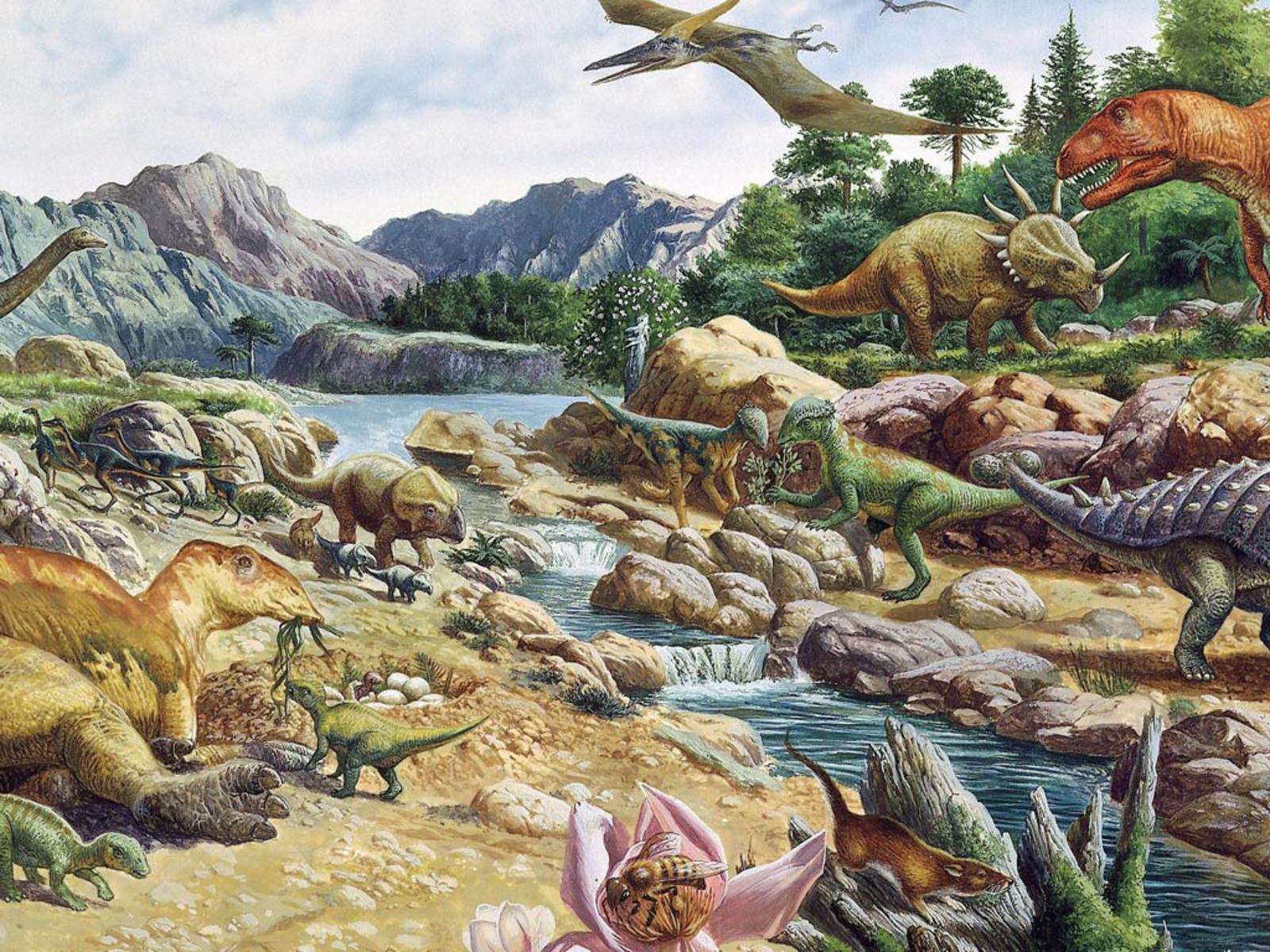
There is, however, a beautiful solution to this dichotomy: what if some dinosaurs were cold-blooded and some warm-blooded? The dinosaur group was incredibly diverse, exploiting many different body forms and sizes, adapted to virtually any kind of environments, evolved numerous feeding strategies and behaviours. Therefore, it seems probable that there also were radically different physiologies across the group.

If the bird-like theropods had to be warm-blooded, that must not mean that the completely different sauropods were too. This is a nice, easy compromise. It makes sense of a lot of information, so it is a good idea in scientific eyes. Also, it makes the dinosaurs so much more interesting to study, because now we must investigate the obvious follow-up question: which dinosaurs were cold-blooded and which were warm-blooded?

I have been reading quite a lot about this topic over the years, and I stumbled upon an intriguing idea that seems to have been overlooked. In a chapter on dinosaur thermoregulation of The Complete Dinosaur (eds. Farlow & Brett-Surman 1997; see Book tips for more details), the now late R. E. H. Reid discussed the possibility that dinosaurs may have been some sort of intermediates between conventional cold- and warm-bloods. Moreover, Reid pointed out that different types of dinosaurs seem to have been closer to true warm-bloodedness than others, and at least the evolutionary sequence that gave rise to birds would have achieved full warm-bloodedness before taking flight. 

I found this proposition both plausible and intriguing. I like it because it makes sense and makes the question yet even more fun! It is this idea that I want to explore in the coming series of posts, where I want to discuss each major group of dinosaurs in the light of this idea. First, I will write about evidence for and against warm-bloodedness in the whole dinosaur group. I’ll break it down into smaller groups later to discuss the different ‘degrees’ of warm-bloodedness they might have had.

Saturday, 6 April 2013

Stigmaria – fascinating fossil from Arran


The field trip to Arran was disappointingly devoid of interesting fossils. But, on the last day, the paleos (plus a group of honorary geologists) went (on an invigorating trip over a mountain) to work on an Arthropleura trackway. Arthropleura was the largest land vertebrate we know, a colossal millipede (or maybe centipede… the actual relationships are not clear) that could grow to over two metres in length! It lived in near-coast areas of the Carboniferous period, some 300 million years ago, and was a heavily protected herbivore that would have fed mostly on plant litter or detritus. 

The group was too large for us all to work on the short preserved trackway, so I was delegated to examine the other fossil on the site: Stigmaria, a plant root belonging to one of the colossal Carboniferous club mosses (which are not mosses at all: they are closer to true trees, but distinguished by having leaves attached directly to the stem, i.e. no branches in between).

Stigmaria is a morphotaxon, a group of body parts that is too poorly known to know its evolutionary origin, but is still given a taxonomic name so that it can be easily referred to. Morphotaxa are common practice in paleobotany, the study of extinct plants, since you rarely find fossils of entire plants, but usually only leaves, pollen, trunks or branches and nothing more. It is then the challenge of paleobotanists to puzzle certain morphotaxa together into a whole organism, if possible (which rarely is the case). Stigmaria is considered to be the roots of Lepidodendron, a 40 metres tall club moss, or lycopod. (So, Stigmaria is part of Lepidodendron, but only Lepidodendron is an actual, classified organism; Stigmaria is just the roots.)

Reconstruction of Lepidodendron with its Stigmaria roots.

No post on the Arran fieldtrip

I am sorry to tell that during the fieldtrip to the island of Arran in Scotland the assessed work we had to do was too much to be able to take any useful photos (or fossils), and none of it makes a story worthwhile to tell here.

Our "adventures" consisted mostly of measuring angles on rocks, trying to pinpoint different rock types on messy, obscure maps, and in general trying to guess what the point of all of this is (since they wouldn't tell you what you were expected to do in the field until after you had already been there...), all under considerable time pressure leaving no time for thinking twice about anything... In other words, it was generally confusing and stressful (until the work had been handed in, marked and returned to us, at which point they told us what we should have seen and done – we understood it in hindsight, but by then it was of course already too late...).

Apart from the poorly organised formal assignments, the trip was really pleasant. The weather was nice and sunny all week, and the company was fantastic! On fieldtrips, you spend so much time with your coursemates and build stronger bonds of friendship and solidarity.

Also, this trip reminded me soooo much about the fell hiking trip in Sweden from last summer: the curvy paths interrupted by bogs and mud pools, the hilly landscapes, the abundant streams of meltwater (Arran had suffered a heavy snow storm just a week ago), the long walks, the brisk air, etc. It was great, because I will sadly not be able to go with the guys on the hike this summer.

Wednesday, 27 March 2013

Fossils from Avon Gorge

Jikes, it was a long time since we went to Avon Gorge, but I first now got down to taking pictures of the fossils (and other rocks) I brought back home. I will not make an extensive post of this either, I'm afraid. I need to prepare for the large fieldtrip we are facing in the end of this week!

These tiny blobs are not fossils, but some odd form of carbonate balls. They could be peloids – fossilised pellets of invertebrate faeces (bug poo) – or maybe ooids, a strange type of round balls with onion-like layers of carbonate around a usually empty core; no one really knows how they are formed, though there have been several guesses, the most accepted to date being that they form as bug mucus coats around some small object and traps carbonate particles around it, slowly forming a round, layered coating of limestone.


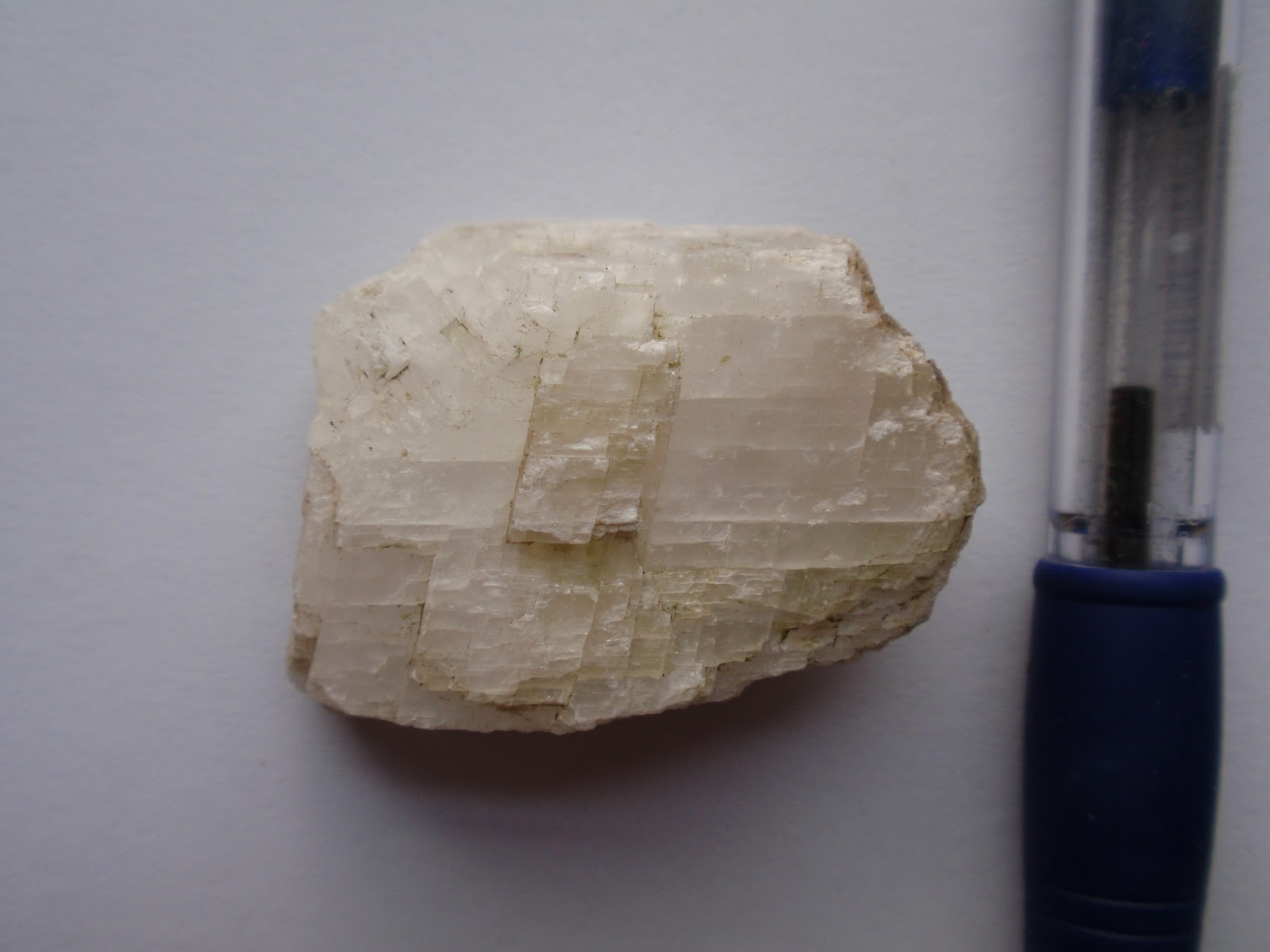
Limestone is basically any sedimentary rock with plenty of calcium carbonate (CaCO3). The mineral (i.e. crystalline) form  of calcium carbonate is calcite, of which I found a rather large, (fairly) pure example. 


Calcite looks a lot like quartz (and a few other grey translucent minerals), but there is a (fun) way of making sure it is calcite. CaCO3 reacts with hydrochloric acid (HCl) to form water (H2O), a salt (CaCl2, which is dissolved in the water, so you can't see it) and gas (hydrogen gas H2 and carbon dioxide CO2) which escapes from the water as bubbles. So, if you pour a drop hydrochloric acid on the rock and it fizzles, there is surely carbonate in it. 


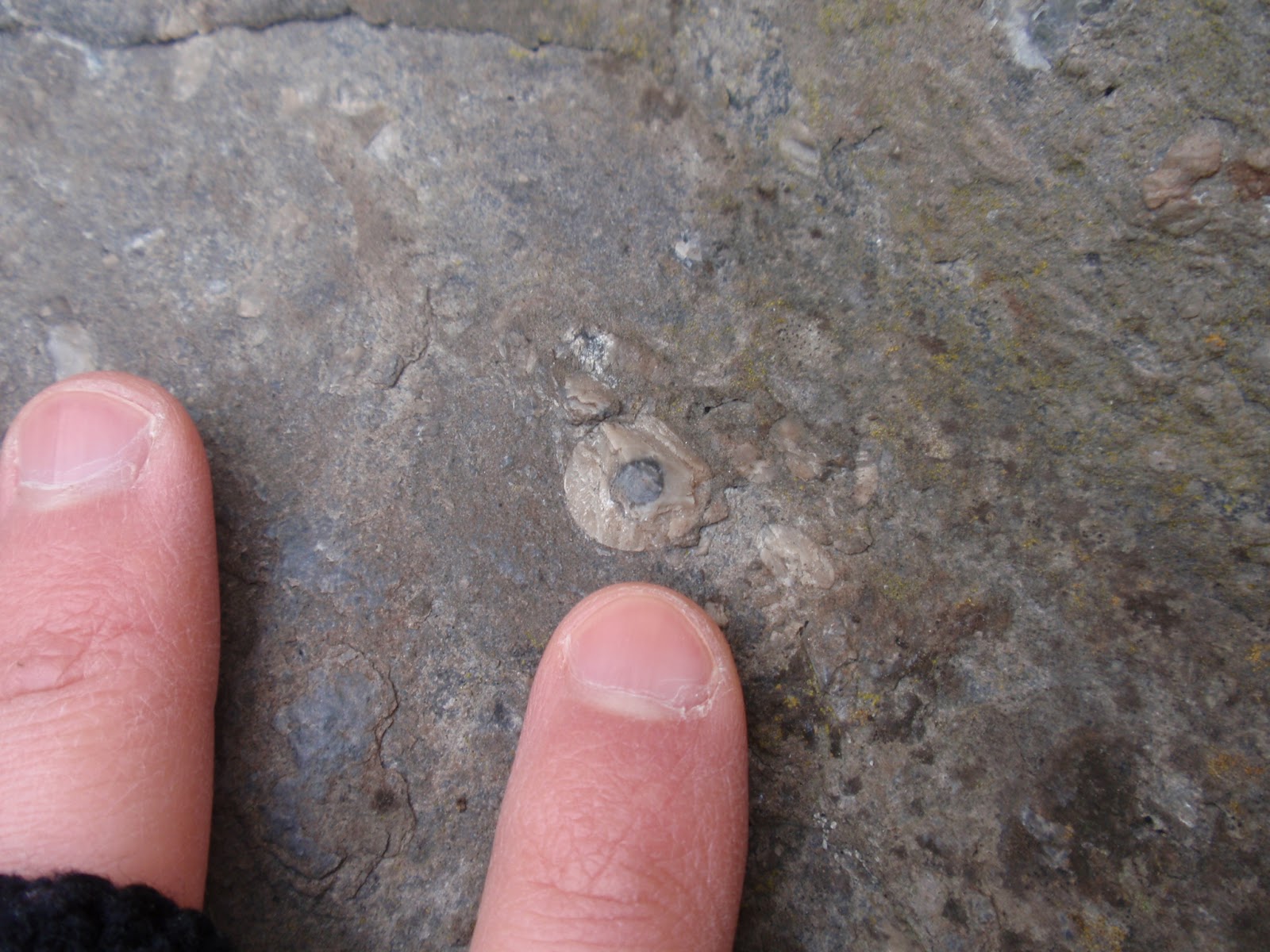
 As for the fossils, a few are less spectacular, such as the two brachiopods below (the second might be har do see from that angle, but to be honest, it is hard to see from any angle!). 


I tend to find crinoids in large, disorganised masses, perhaps because they have been thrown around by strong currents. 


It is a shame, because I find them rather adorable from time to time (even though I always only find bits of stalks...). Albeit not remarkably interesting anatomically, these buggers have their charm.

More to my current interests, I found a few rugose corals.


Where is the little coral there? Actually, I just noticed it when I was taking the picture. Let me zoom in for you.


Look at the part where it has been broken in two. The inward-facing groovey thingies are tell-tale signs that it is a rugose coral.

And here are finally some nice brachiopods.


The end.

Please understand why I cannot make too many elaborate posts. I would be happy to, but time needs to be budgeted, and so on.

However, for the mammoth field trip to the island of Arran in Scotland, I promise you an interesting story, if anything about surviving in a God-forsaken island that has recently sufferet from a long, heavy power-cutting snow storm, where the visitors were stranded because the ferries were cancelled. That of course does not stop hard-core geologists...


Monday, 18 March 2013

Avon Gorge fieldtrip

Monday the 11th of March we had another one-day fieldtrip with the first-year geology group, this time to a site within Bristol: the Avon Gorge.

As scary as the name sounds (I have no idea of what it means, but the words sound ominous), the only frightening thing was the size of it.


(And that bit continues below!)


(We went to a few other sites, but this exposure was the main part, and where all fossils were found, so I will only retell our adventures here.)

I have been very unproductive in terms of blogging of late, simply because I really need to do more schoolwork now than ever before, plus search for and arrange accomodation for next year, prepare for the one-week field session we are having during the break, and begin to plan my summer (work, rehabilitation exercise for my bad knees, and I want to bring some friends from Bristol over), and do not forget the scientific method post I am working on (which seems like it will be massive, so I am considering cutting it into pieces and publishing them one at a time instead of the whole thing when it is all finished...)!

(However, I am intending to resurge my blogging soon, and especially include more discussions around material from our classes. I have a few ideas that could be of interest! Hopefully, it will bring a new dimension to this blog. I will also try to resume the PalQuizes.)

So, for this fieldtrip, I will actually dismember the narrative to focus on the fossils only. (Really, they were the only fascinating bit: the rest fell pale, especially since, typically, that day was like the coldest day of the year!)

Some fossils were large and clearly visible from far away.


There are some clear echinoderms – starfish, to be precise – and a few indeterminate worm-like creatures I have never seen before, so it was quite fun to see something new.

We found plenty of crinoids in the exposure wall (though the first one could perhaps be a rugose coral...). 


A really nice impression of a stalk plate: 


Another impression, this time of the side of the stalk, showing the contours of several plates: 


There were also plenty of rugose corals.


The last one is adorable! I think it was Nigel who found it. He finds all the nice ones, so it probably was. *grumble*


However, I did made one rather amazing find. We were told that there would basically only be crinoids and rugose corals here, and indeed, it seemed so...

*TAH-DAM-DAM-DAAAM*

... until I saw this:


Some form of shelled creature, most likely a brachiopod impression from the side. The top part would be its dorsal shell (upper shell) and the bottom its ventral shell (bottom shell), which is larger. In life, it would sit on the seabed on a fleshy stalk sticking out from the tip you can see on top right there, and it would sit upside down – i.e. with its ventral shell upward – and stick out a tentacly tongue-like structure from its other end (bottom left) to filter food particles from the water.

Brachiopods are one of my favourite invertebrate fossil groups, and this is one of the finest specimens I have seen in the field. A really successful day after all!

We also found plenty of fossils to bring back home, and I will show them in another post.


Tuesday, 26 February 2013

Sand Bay


Monday the 25th of February, we went on a short fieldtrip with half the first-year geology group to Sand Bay in Weston-super-Mare, near Bristol.

The rocky shore we were at is within the tidal zone, so during high tide, it lies under water. We were therefore working under considerable time pressure, and the slightest delay could mean the lives of every single member of the group!


No, just joking… (I gave up puns for lent, so I have to make do with other forms of low humour.) The tide does not come in that fast, and as long as you always keep an eye on the water level, you should be fine. The greatest danger here would be standing too close to those cliffs for too long.


But, again, be careful with where you stand, and, if you have to go up close, do it quickly and then go back immediately. If you do that, there is little risk.

The beach was full of round limestone rocks, nicely polished by the washing waves every day. It did not take long before all paleontologists were scanning them for fossils.

As always, there is this mysterious lag period where you walk around, staring at the ground, but find nothing. You bend down to have closer look, but still don’t see a thing of note. It is not until you find the first that the rest start to crop up everywhere, even where just had just passed – which ironically turns out to be packed with nice fossils that you for some reason were blind to a minute ago.

The point of this fieldtrip was to teach us certain geological field skills. The university staff here seems to have a fetish for the word ‘skill’, and gladly apply it to anything that relates to an ability, no matter how undeveloped. I guess it is just that it sounds good when you say that the students are acquiring skills in the field. It makes us sound professional. (The same goes for the word ‘feedback’, but this is not the place to be bitchy about the meaning of words…)

We had four exercises to do. So, get on with it.

I don’t want to sound cranky, but it is difficult not to, when the teachers do not even care to show us how to do the things we are tasked to do in the exercises. Half of us have never done fieldwork in geology before. In the blistering cold winds, and surrounded by fascinating fossils, the motivation for walking around and trying to guess what they want us to do dropped to the bottom.

Luckily, James, Nigel and I had done many of these things before, so we did fine, but there was still much hesitation and standing with the notebook and pencil in cold-shivering hands glaring at an outcrop in front of us, each probably having an internal struggle to find any point in this. We want to search for and find nice fossils!

In the end, we did what we had to, but, in hindsight, it could have been done half as painfully and in half the time if we had just been prepared properly by the staff that has years of experience of these things and therefore should be able to go through each step clearly and give tips from personal experience on how to make things more efficient.

They did not give much introduction to the history of this place, except for the brief notes they had given us in a handout earlier. All we knew was that the rocks were Carboniferous of age and formed in a shallow marine environment, and that there were some volcanic sediments mixed around here as well.

The idea was for us to start to investigate the environment for ourselves and try to puzzle some pieces together, rather than having someone give us all the answers. Brilliant pedagogical thinking, in theory at least. Honestly, I am glad they at least try.

But argh, don’t let me spoil this post by complaining so much! It was a really good day! It had been so long since I saw fossils (in real life).

What I really was hoping to find was a rugose coral, since I don’t have any yet. I have plenty of tabulate corals – the other main type of corals at that time – including my very first fossil. Both types of corals lived on the bottom of shallow seas, filtering food particles directly from the water. That is about as much as they did… (I’m not sure of how they reproduced, but cnidarian life cycles tend to be quite interesting, so maybe the fun bits happened then!) The tabulate corals grew in tight colonies, and so were very important for building ancient reefs; the rugose corals were more solitary.


And some were small enough to bring back home.


What has been preserved is the calcareous outer skeleton it secreted outside its body; the actual animal would live inside, protected from most danger, and let out its tentacles to feed from the currents. Perhaps not the most fantastic of organisms, but they make very nice fossils!

A really amazing one I found embedded in a huge block of rock (too big to carry) (and too stuck in the rock to pick out) could be a rugose coral preserved in very nice, large, clear calcite crystals, but it could also be a crinoid (sea lily), another filter-feeder, but related to starfish and sea urchins.


I found at least one fossil that is surely a crinoid.


But only a cross section of one of the hard plates of its stalk, so not really much to see. Nigel, on the other hand, found a fantastic bit of its mouth and tentacles! It was so incredibly nice, that James and (mostly) I were bitter and jealous for hours (not really, but we pretended, because it was the best we could do… damn Nigel! hahaha).

And as if it was not enough, Nigel later found a huge rugose coral, only half attached to a rock, the other side nicely showing its cone shape. Damn that man again!

I did find a pretty fun crinoid fossil with its stalk plates sort of separated a bit.


I also picked up something I am quite sure is a brachiopod.


And, finally, a rock that looks just like the typical textbook model of dip-slip faults!


(If you are unfamiliar with what that is, don’t worry… it is really only funny if you have seen tons and tons of those diagrams before.)

In two weeks or so, it is time for another fieldtrip, but this time probably with less fossils. *sob*